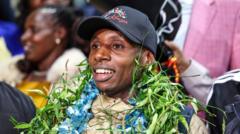
Kenya's Sabastian Sawe was greeted with an outpouring of joy and celebration upon his return home, as supporters and family members gathered to honour the athlete who etched his name into the history books of long-distance running.
Sawe, who became the first man to officially break the two-hour marathon barrier in a competitive race, admitted he was caught off guard by the scale of the reception. "I did not expect it," the runner said, reflecting on the extraordinary welcome he received from his community.
The achievement marks a watershed moment in athletics history. While other elite runners had previously come close to or broken the two-hour mark in specially organised time trials, Sawe's accomplishment stands apart as it was achieved in a legitimate competitive race setting, making it officially recognised within the sport.
Kenya has long been one of the world's dominant forces in marathon and long-distance running, producing generations of world champions and record breakers. Sawe's achievement only adds to the nation's extraordinary legacy in the sport, and the jubilant scenes greeting his homecoming reflected just how deeply running is woven into the fabric of Kenyan national pride.
The celebrations underscored the significance of the milestone, not only for Sawe personally but for his country as a whole. Athletes, fans, and community members all turned out to welcome back a man they view as a national hero.
The two-hour marathon barrier had long been considered one of sport's ultimate frontiers, comparable in significance to Roger Bannister's breaking of the four-minute mile in 1954. For decades, coaches, scientists, and athletes had debated whether human physiology would ever allow such a feat to be accomplished in a genuine race environment.
Sawe's historic run has now answered that question definitively, and his return home served as a reminder that behind every sporting milestone is an athlete shaped by community, family, and unwavering determination.