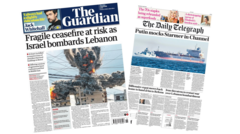
Britains leading newspapers are dominated on Thursday by concerns over the stability of a recently brokered ceasefire agreement involving the United States, Israel, and Iran, as well as sharp criticism directed at Prime Minister Keir Starmer from Russian President Vladimir Putin.
The fragile two-week ceasefire deal, which was agreed between the US, Israel, and Iran, has drawn significant attention from editors and commentators across the political spectrum. Several front pages warn that the agreement may be under serious strain, raising fears about what a breakdown in the truce could mean for an already volatile and deeply troubled region.
The deal represents a significant diplomatic effort, particularly from the United States, which has long sought to manage tensions between Israel and Iran. The two nations have been locked in a state of deep hostility for decades, with concerns over Irans nuclear ambitions and proxy conflicts across the Middle East frequently threatening to escalate into direct confrontation.
Alongside the ceasefire coverage, a number of papers are also highlighting remarks made by Vladimir Putin that appear to take aim at Prime Minister Keir Starmer. The Russian president's mockery of the Labour leader has attracted considerable media attention in Britain, coming at a time when the UK government has been navigating its position on the conflicts reshaping global geopolitics.
Starmer, who took office in 2024 following Labours general election victory, has sought to maintain strong ties with Western allies while also grappling with the economic and diplomatic pressures that ongoing international instability continues to place on Britain. Putins comments are seen by many observers as part of a broader pattern of Russian attempts to undermine Western leadership figures.
The juxtaposition of the two major stories reflects the extraordinary pressure points currently defining global affairs. From the Middle East to Eastern Europe, world leaders are facing intense scrutiny over their handling of fast-moving and deeply consequential events.
Political analysts suggest that the coming days will be crucial in determining whether the ceasefire holds and whether diplomatic channels can be strengthened before the agreement expires. The mood across Thursdays front pages is one of cautious unease, with many commentators warning that optimism must be tempered by the deep complexities that have long made lasting peace in the region so difficult to achieve.