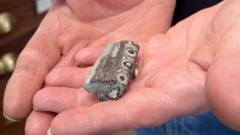
A tourist has made a remarkable discovery after stumbling upon a rare jawbone belonging to what is believed to be one of the oldest known sea crocodiles ever recorded. The unexpected find has excited palaeontologists and fossil enthusiasts alike, shedding new light on these ancient marine predators.
The fossil, belonging to a Thalattosuchian — an extinct group of crocodyliform reptiles that dominated the seas during the Mesozoic Era — was discovered during a guided fossil walk organised by a local museum. The find was entirely by chance, a reminder that some of history's most significant scientific discoveries can come from the most unexpected moments.
Thalattosuchia, commonly referred to as sea crocodiles, were remarkable creatures that lived approximately 180 to 190 million years ago. Unlike their modern-day relatives, these ancient reptiles were highly adapted for life in the ocean, possessing streamlined bodies, flipper-like limbs, and powerful tails that allowed them to navigate prehistoric seas with ease.
The guided fossil walk, run by a museum, provided the fortunate tourist with the opportunity to explore terrain known for its geological significance. Such walks are designed to engage members of the public with natural history and the science of palaeontology, and in this instance, yielded an extraordinary result.
The discovery of the jawbone is considered particularly significant given the rarity of Thalattosuchian remains. Fossils from this group are not commonly found, making each new specimen a valuable contribution to scientists' understanding of how these creatures evolved and spread across ancient oceans.
Experts are expected to further examine and analyse the jawbone to determine its precise age and what species of Thalattosuchian it may belong to. Such analysis could provide important clues about the evolutionary history of early marine crocodilians and their place within the broader prehistoric ecosystem.
The find serves as a testament to the enduring importance of public engagement with science and natural history, demonstrating that amateur discoveries made during organised educational activities can have a profound impact on our understanding of life on Earth millions of years ago.