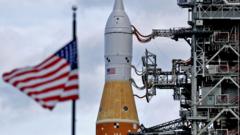
NASA's Artemis programme is edging closer to a historic milestone, with the first crewed Moon mission in half a century potentially set to launch as early as April. The mission marks a significant step in humanity's return to lunar exploration after decades away from Earth's closest neighbour.
The Artemis programme, named after the twin sister of Apollo in Greek mythology, represents NASA's ambitious effort to not only return astronauts to the Moon but to establish a sustainable human presence there. It builds on the legacy of the Apollo missions, which last landed humans on the lunar surface in 1972.
The upcoming crewed mission is expected to serve as a precursor to an actual lunar landing, carrying astronauts on a journey around the Moon rather than touching down on the surface. This approach allows NASA and its international partners to test critical systems and procedures before committing to a full landing attempt.
The broader Artemis programme has faced a series of delays since its inception, making the potential April launch date a closely watched target for the space community. NASA successfully completed an uncrewed test flight in late 2022, which paved the way for the next phase involving human passengers.
One of the most notable aspects of the Artemis programme is its commitment to landing the first woman and the first person of colour on the Moon, broadening the historic achievement beyond what the Apollo era accomplished. International collaboration also plays a central role, with agencies including the European Space Agency, the Canadian Space Agency, and the Japan Aerospace Exploration Agency all contributing to the effort.
The mission represents far more than a nostalgic return to a destination humanity has visited before. Scientists and space agencies see the Moon as a stepping stone toward deeper exploration of the solar system, including an eventual crewed mission to Mars. With the April launch window drawing closer, anticipation continues to build around what could be one of the most watched space events in a generation.