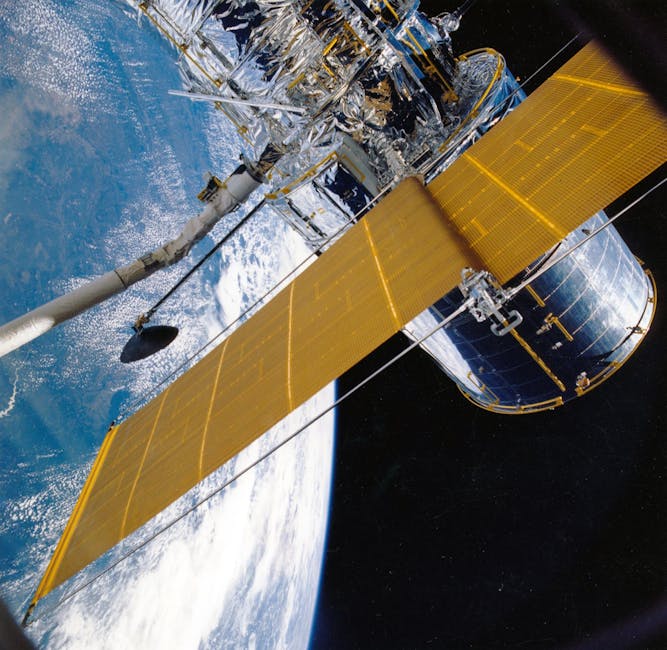
NASA is exploring whether private spaceflight companies could extend the life of the Hubble Space Telescope by boosting it to a higher orbit, according to The Verge. Without intervention, the telescope's gradual orbital decay will eventually cause it to re-enter Earth's atmosphere, with the window for action narrowing toward the early-to-mid 2030s.
To understand why this matters, it helps to remember what Hubble represents — both scientifically and politically. Launched in 1990 and famously repaired by Space Shuttle astronauts after its initial mirror flaw was discovered, Hubble became the most publicly beloved scientific instrument in history. Its images have shaped how an entire generation understands the cosmos. More concretely, it continues to produce peer-reviewed science, often in coordination with the James Webb Space Telescope, which operates in a fundamentally different infrared wavelength and serves as a complement rather than a replacement. Losing Hubble would not simply be a nostalgic loss — it would close a specific observational window that no currently funded successor is designed to reopen.
The orbital decay problem is a straightforward consequence of physics. Even at Hubble's altitude, trace amounts of atmosphere create enough drag over time to pull the telescope downward incrementally. During the Space Shuttle era, servicing missions performed by astronauts included reboosts as a matter of course. When the shuttle program ended in 2011, that capability went with it. NASA has known for years that Hubble was operating on borrowed time without a boost, and the question has always been less about whether the orbit would decay and more about whether a cost-effective solution could be found before the situation became irreversible.
That context makes the agency's turn toward the commercial sector legible as something larger than a single procurement decision. It is a test case for what the new spaceflight economy can actually do when given a problem that falls outside the traditional launch-and-deploy model. SpaceX, with its Crew Dragon and Starship programs, and other commercial operators have demonstrated the capacity to reach and maneuver in low Earth orbit with increasing reliability. The question of whether any of those vehicles could rendezvous with, dock to, or otherwise interact with a legacy satellite not designed for commercial servicing is a meaningful engineering challenge, and the answer will have implications well beyond Hubble.
SpaceX conducted a study in partnership with the Polaris program a few years ago examining the feasibility of a Hubble reboost using a Crew Dragon capsule. That study suggested the idea was technically plausible but raised unresolved questions around grappling a spacecraft that was never designed with commercial docking hardware in mind. NASA's current call for proposals, as reported by The Verge, suggests the agency believes those questions are worth pursuing more formally, even if no mission has been approved or funded.
The consequences of success or failure here extend in several directions. For NASA, a successful commercial reboost would validate a broader philosophy the agency has been cultivating for more than a decade — that it can offload certain operational responsibilities to private operators and focus its own resources on deeper exploration. For the commercial space industry, winning and executing such a mission would represent a significant expansion of the serviceable market. Satellite servicing, including refueling and orbit adjustment, has long been discussed as a commercial opportunity; Hubble would be a high-profile proof of concept. For the scientific community, the calculus is simpler and more urgent: more years of observation time on a mature, well-understood instrument with a library of legacy data is an outcome worth considerable effort to secure.
There are risks worth naming plainly. Hubble was not designed to be serviced by commercial vehicles using modern docking standards, and any physical interaction with the telescope carries the possibility of damaging it. The cost of a commercial reboost mission remains unknown and could prove prohibitive in a constrained budget environment. There is also the question of timeline — the orbital window in which a reboost remains practical is not unlimited, and procurement and development cycles in the space industry are not short.
What to watch for in the near term is which companies respond to NASA's call for proposals and what architectures they put forward. The technical approach matters enormously here: whether proposals lean on robotic rendezvous, crewed missions, or some hybrid will signal how mature commercial satellite servicing technology actually is. Also worth watching is how Congress responds, since any funded mission will ultimately require appropriations, and Hubble's unusual public prominence could work either in its favor or expose the effort to scrutiny as a sentimental rather than scientific priority. The telescope has defied predictions of obsolescence before. Whether it does so again will depend less on physics than on institutional will and commercial ingenuity.